Stop Guessing What Your Credit Report Means.
Grade letters and status codes with no explanation? Not anymore. Upload your report and get a plain-English breakdown of exactly what lenders see.
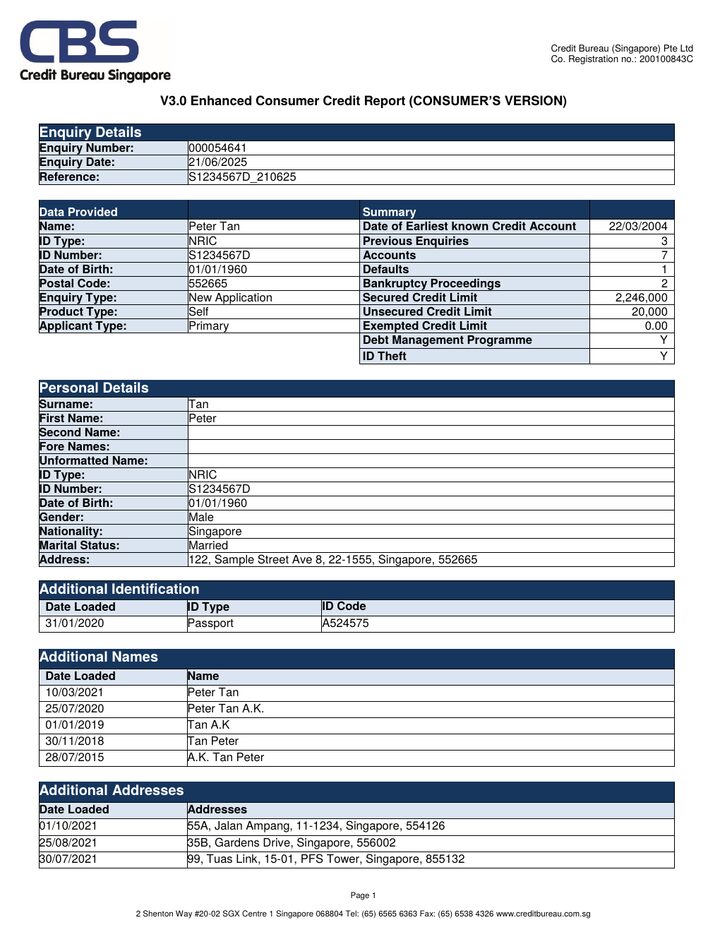
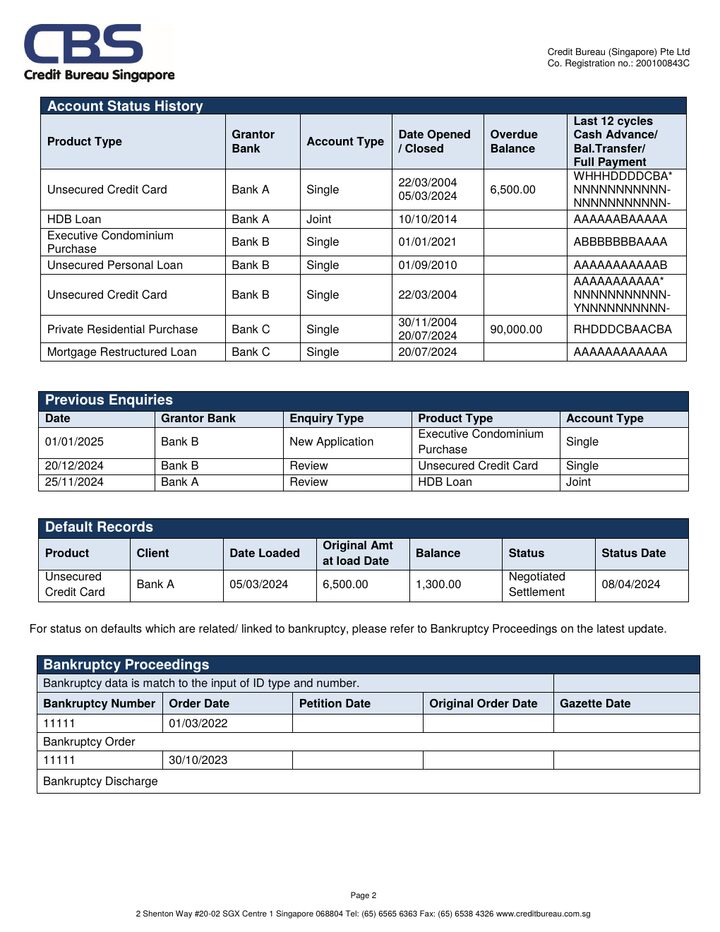
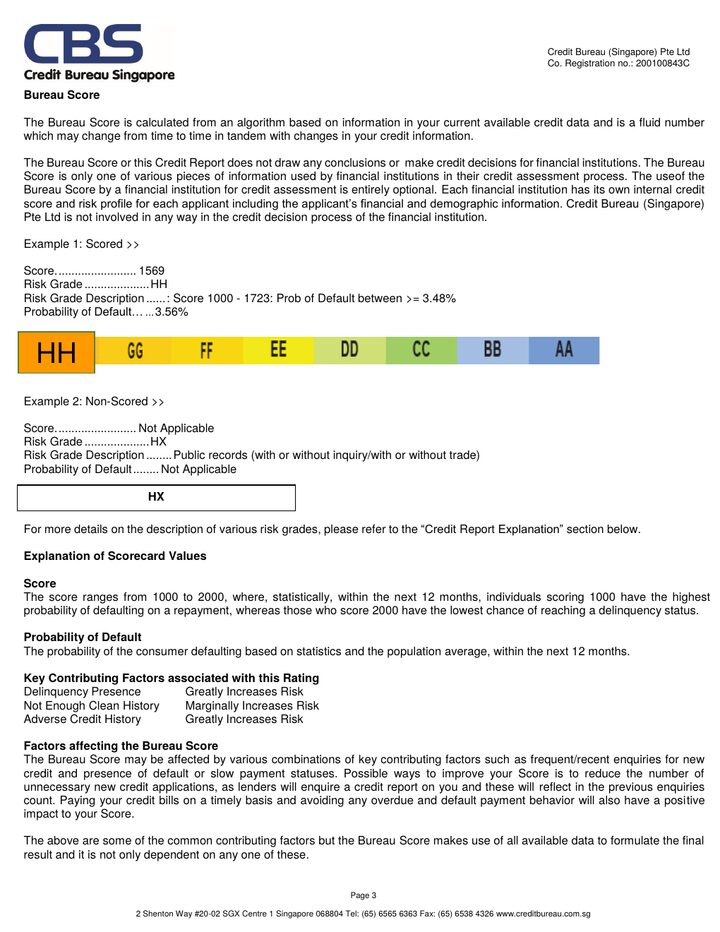
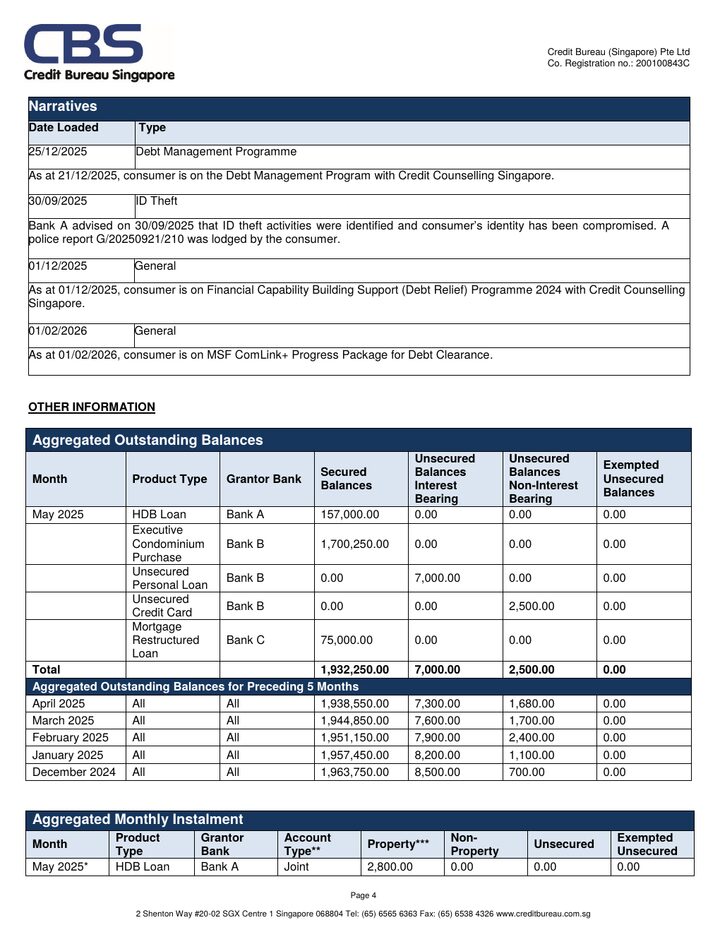
Before you apply for a loan
Whether it is an HDB housing loan, an EC, a renovation loan or a car loan, banks and lenders pull your CBS report when you apply. Your report records your accounts, balances, enquiries and status codes, and it is written for lenders, not for you. Credit Clarity explains each part in plain English, so you know what is on your report before a lender reads it. Lenders look at more than this report when they decide on a loan or credit application.
Enquiries
Your report shows 7 enquiries in total. Enquiry records are kept for 2 years from the date of each enquiry.
New Application enquiries (made by lenders; these are included in the Bureau Score calculation):
There are 2 New Application enquiries:
- 9 January 2026, DBS, Unsecured Credit Card
- 21 October 2025, OCBC, Unsecured Credit Card
Review enquiries (made by existing lenders; these do not affect the Bureau Score, as stated by CBS):
There are 5 Review enquiries:
- 3 March 2026, DBS
- 2 December 2025, OCBC
- [ + 3 older review enquiries hidden for clarity ]
There are no self-enquiries and no Guarantor enquiries in this report.
This is a sample layout mockup, not the final product.
How It Works
Three steps. Nothing kept afterward.
You upload your CBS report
The same PDF Credit Bureau Singapore sends you. Nothing else is required.
We process it, then discard it
Your report is read once to generate your explanation. The file and its contents are not stored afterward. We explain what CBS has recorded; we do not verify or alter the underlying report.
You get a plain-English explanation
Each grade, status code, and record explained in ordinary sentences. No recommendations, no predictions about approval, no score-improvement claims. Just what the terms mean.
Sample Report
What a CBS report says, next to what it means
This is a worked example, not your actual report. It shows the kind of translation Credit Clarity produces once you upload your own.
From the CBS Report
In Plain English
Status W means the lender recorded this account as a default. It does not confirm repayment or cancellation of the debt.
Risk grade HX is a non-scored category associated with public records. It applies at report level, not to this individual account.
62 days in arrears means a payment was overdue by roughly two months at the point this was recorded.
Reference
A short glossary of terms on your report
Every risk grade and status code on a CBS report has a specific, defined meaning. Here are four of the most common ones.
AA: Bureau Score Band
The Bureau Score band from 1911 to 2000. This is a report-level grade, not a certificate that an individual account has no adverse history or a guarantee of approval.
HX: Non-scored Category
A report-level category for public records, with or without enquiries or account records. It is not a historical grade assigned to an individual account.
Status W: Default Recorded
The lender recorded an account default. The code alone does not confirm a closure date, repayment or cancellation of the debt.
Enquiry
A record that a lender accessed your report, usually because you applied for credit. Not every enquiry is treated the same way, and CBS's own documentation explains which types are counted where.
About the Founder
Ten years ago, I needed this and it didn't exist
Credit Clarity was not built by a bank or a credit bureau. It was built by someone sitting at home, staring at a CBS report full of grade letters and status codes, with no explanation anywhere in the document. When he finally asked a banker what it meant, the answer was "It's bad, you need to make payment."
A confused borrower doesn't push back, doesn't ask questions, and accepts worse terms. That gap, between banks who read these reports fluently and everyone else who can't, is why Credit Clarity exists. One report, explained plainly, one at a time.
Feedback
Have feedback or a question?
Leave a comment, a suggestion, or a question if you need help. We read every message.